10 Amazon Rainforest Facts That Will Change How You See the Planet
The Amazon is so enormous that some of the things happening inside it sound made up. It creates its own rain, carries a river beneath a river, and contains animals that still manage to surprise scientists

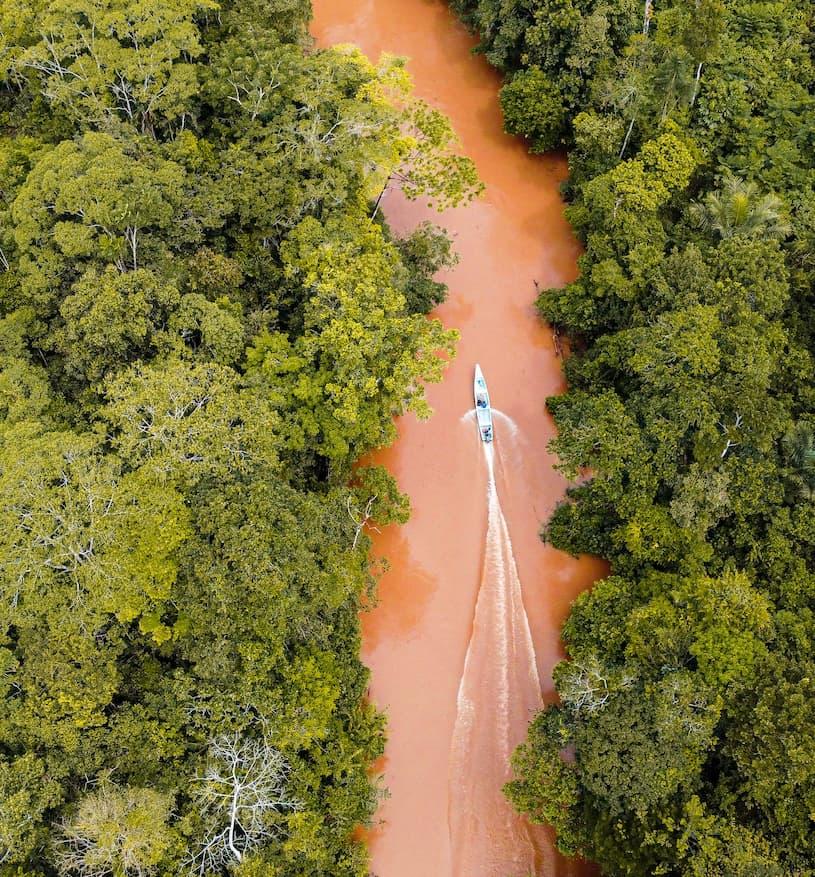
The Amazon is so enormous that some of the things happening inside it sound made up. It creates its own rain, carries a river beneath a river, and contains animals that still manage to surprise scientists. And once you understand how this place actually works, the familiar image of “a really big forest” starts feeling wildly inadequate.
A Forest That Makes Its Own Weather
1. The Amazon helps create its own rain
Trees in the Amazon don't just wait around for rain. They help make it. Their roots pull water from the soil, and their leaves release huge amounts of water vapor into the atmosphere through a process called transpiration. That moisture helps form clouds and eventually falls as rain, sometimes hundreds or thousands of kilometers away. Scientists often describe these moving streams of atmospheric moisture as “flying rivers.” You can't see them, but entire regions depend on them.
2. One tree can pump hundreds of liters of water into the air
Picture a large Amazon tree as a giant biological water pump. On a typical day, a mature tree can release hundreds of liters of water through its leaves, with estimates for very large trees reaching roughly 1,000 liters under some conditions. Multiply that by hundreds of billions of trees and the scale gets ridiculous fast. The forest moves so much moisture that it can influence rainfall far beyond the Amazon basin, including major farming regions across South America.
The Numbers Get Weird Fast
3. The Amazon rainforest covers around 5.5 million square kilometers
Maps don't really prepare you for the size of this place. The rainforest itself covers roughly 5.5 million square kilometers, while the wider Amazon basin stretches across about 7 million. Brazil holds most of it, but the Amazon reaches into several other South American countries and territories too. If you tried crossing its forested heart on foot, you'd encounter rivers wider than many cities before you even started worrying about snakes, insects, heat, or navigation.
4. Around one in ten known species lives in the Amazon
For every ten species scientists have described worldwide, roughly one has a connection to the Amazon region, according to widely cited conservation estimates. We're talking jaguars, pink river dolphins, poison frogs, giant otters, monkeys, birds, fish, insects, fungi and plants in absurd variety. And scientists haven't catalogued everything. New species still turn up regularly, which means any biodiversity figure you see today comes with an invisible footnote: there are more waiting to be found.
5. A single hectare can contain more tree species than entire countries
Walk through one hectare of Amazon forest and you could encounter hundreds of tree species. For comparison, the whole of the United Kingdom has only a few dozen native tree species. That diversity means the Amazon doesn't resemble the neat forests you might picture elsewhere, where a handful of species dominate the landscape. Two neighboring trees may belong to completely different branches of the plant family tree. For researchers trying to identify everything, that's both a dream and a logistical nightmare.
The Amazon Has Some Very Strange Engineering
6. There's another huge river system beneath the Amazon
In 2011, researchers described evidence of a vast underground flow thousands of meters below the Amazon basin. It became popularly known as the Hamza River, although calling it a normal underground “river” oversells the comparison. The water moves extremely slowly through porous rock rather than rushing through a giant subterranean tunnel. Still, the scale is wonderfully weird: a massive flow of groundwater appears to follow roughly the same west-to-east direction as the Amazon above it.
7. The Amazon River can push fresh water far into the Atlantic
When the Amazon reaches the ocean, it doesn't politely disappear into the salt water. Its discharge is so enormous that relatively fresh water can spread far offshore, changing the Atlantic's salinity and color across a huge area. The river releases more water than any other river on Earth. Sailors near its mouth historically could encounter drinkable or nearly fresh surface water while still out at sea, an impressive trick for a river you've technically already left behind.
8. The forest floor is darker than you'd expect
A rainforest sounds like a place where plants should grow everywhere. But stand beneath a mature Amazon canopy and you may find the ground much more open than expected because the leaves above grab most of the sunlight. Only a small fraction reaches the forest floor in many areas. That's why so much of the competition happens vertically. Vines climb trunks, young trees wait years for a gap in the canopy, and plants develop oversized leaves to catch whatever light slips through.
Some Residents Sound Invented
9. Electric eels can deliver shocks of more than 800 volts
The name already gives away the basic trick, but the numbers are still ridiculous. Researchers have documented an electric eel species, Electrophorus voltai, producing shocks up to 860 volts. That's the highest recorded discharge from a living animal. And electric eels aren't actually true eels. They're a type of knifefish that uses specialized electric organs for hunting, navigation and defense. Somehow, “Amazonian fish with a built-in high-voltage weapon” is the more accurate description.
10. The Amazon contains evidence of huge pre-Columbian societies
The old image of the pre-European Amazon as an untouched wilderness with only tiny, scattered communities doesn't hold up well anymore. Archaeologists have found earthworks, roads, settlements and patches of human-made fertile soil called terra preta. Some Indigenous societies deliberately enriched poor tropical soils with charcoal and organic material, creating dark earth that can remain unusually fertile centuries later. Parts of what looks like pristine nature today carry the fingerprints of people who shaped the landscape generations ago.
The Amazon starts looking different once you realize it's part forest, part weather machine, part biological library and part human history book. Share this with someone who'd never believe number 6 without checking it for themselves.

Devon Walker
Author at SofaBreak — writing on facts and everyday curiosities.