The Strange Physics of Why Spinning Things Do Not Fall Over
A bicycle can balance on two skinny wheels at speed, yet tip over almost immediately when you stop

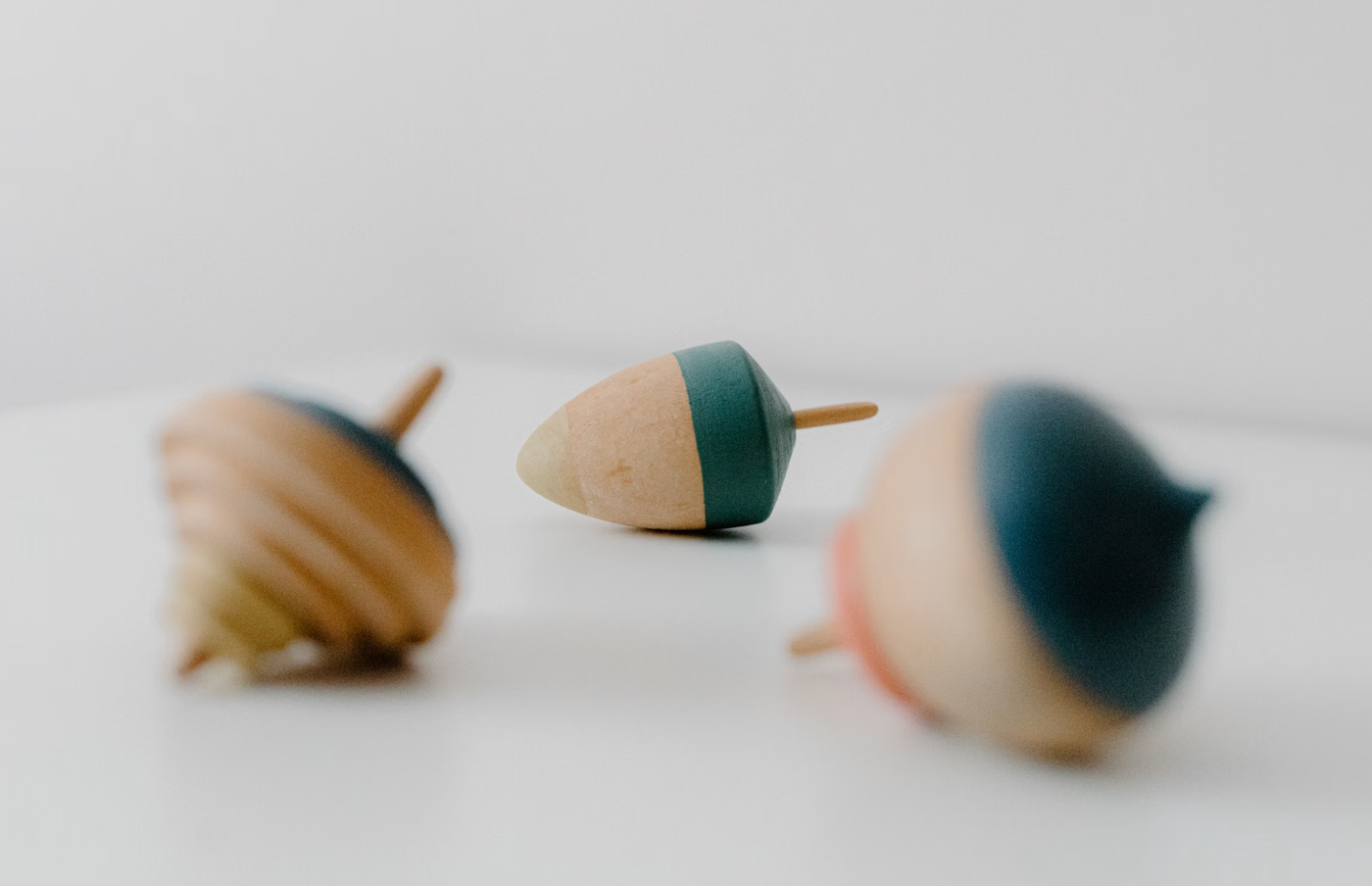
A bicycle can balance on two skinny wheels at speed, yet tip over almost immediately when you stop. A spinning coin suddenly seems stubborn about falling, and a toy top can stand on a point that looks far too tiny to support anything. The weird part is that the explanation isn't quite the one most people think.
The Trick Hiding in the Spin
1. Spinning creates angular momentum
When something spins, it gains angular momentum, a kind of rotational motion that resists sudden changes in direction. The faster it spins, the harder you have to work to redirect that motion. You can feel this yourself with a spinning bicycle wheel held by its axle. Try turning it sideways and the wheel seems to push back. Nothing mysterious pulls it upright. Its existing motion simply makes changing its orientation harder.
2. Gravity still tries to knock it over
Spin doesn't switch gravity off. A spinning top still feels its full weight, and gravity keeps pulling its centre of mass downward. But instead of making the top immediately collapse, gravity produces a turning force called torque. That force changes the direction of the top's angular momentum. Here's the odd result: gravity can make the top's axis move sideways around a circle instead of simply sending the whole thing crashing down.
3. A falling top actually turns sideways
Watch a good spinning top closely and you'll notice its stem tracing a slow circle. Physicists call that motion precession. Gravity pulls downward on the top's centre of mass while the contact point stays planted on the table, creating torque. Because the top already has angular momentum, that torque redirects its axis sideways. So the top responds to a force that seems to say "fall" by moving in a completely different direction.
Your Eyes Miss Half the Action
4. Faster spinning usually means slower wobbling
Give a top a weak spin and you'll see its axis sweep around quickly before it falls. Spin it hard and that sideways precession can become much slower. That's because greater angular momentum makes the same gravitational torque less effective at changing the top's orientation. So a faster-spinning top often looks calmer even though enormous rotational motion hides inside it. Speed, strangely enough, can make the whole object appear more settled.
5. Friction both helps and ruins the trick
Friction sounds like the enemy because it drains energy from a spinning object, and eventually it is. But contact forces at the tip also help determine how a real top moves across a surface. As friction and air resistance steal rotational energy, the spin slows and gravity gains the upper hand. That's when the wobble grows dramatic. The frantic dance near the end isn't extra energy appearing. You're watching stability disappear.
6. A bicycle isn't just a giant gyroscope
You've probably heard that bicycles stay upright because their wheels act like gyroscopes. That's only part of the story. Researchers have built bicycles that can balance even after cancelling much of the wheels' gyroscopic effect. Steering geometry matters too. When a moving bike starts leaning, its front wheel can steer into the lean and bring the contact points back under the rider. Your tiny steering corrections also do a huge amount of work.
Things Get Weirder Off the Ground
7. Astronauts use the same physics
Spacecraft can't push against the road because there isn't one, but spinning hardware still lets them change orientation. Devices called reaction wheels spin inside some satellites. Speed one wheel up and the spacecraft rotates the opposite way, conserving angular momentum. Slow it down and the spacecraft responds again. Engineers can point telescopes and instruments with extraordinary precision using this trick, all without needing to fire a thruster for every small adjustment.
8. A spinning bullet uses the trick too
Rifling inside a gun barrel gives a bullet rapid spin around its long axis. That rotation helps keep the projectile from tumbling through the air, much as a spinning top resists having its axis redirected. The idea reaches far beyond bullets. American football players throw tight spirals for similar stability, and a well-thrown flying disc depends heavily on spin. Rotation turns otherwise twitchy objects into much more predictable travellers.
9. You can wrestle angular momentum with your hands
A spinning wheel makes the physics feel almost alive. Hold a bicycle wheel by both ends of its axle, spin it quickly, then try tilting it. Instead of moving neatly where you push, the wheel tries to twist in another direction. Sit on a swivel chair and the effect gets even better: changing the wheel's orientation can rotate your whole body. The wheel hasn't developed a mind. Conservation laws are transferring rotational motion through you.
Why the Magic Always Ends
10. Nothing stays upright forever
A real spinning top eventually loses because air resistance and friction keep stealing its rotational energy. As its angular momentum drops, gravity can change its orientation more quickly, the precession becomes increasingly obvious, and the motion turns messy. Then comes that rapid final wobble before the top clatters flat. What looks like a sudden failure has actually been building from the first second. The spin has been spending its stability the entire time.
A spinning object isn't escaping gravity. It's responding to gravity in a wonderfully sideways way, and once you notice that, every bicycle wheel, football and desk toy starts looking a little stranger. Share this with someone who still thinks a spinning top stays upright because it's simply "going too fast to fall."

Craig Anderson
Author at SofaBreak — writing on facts and everyday curiosities.