10 Facts About the Sun That Will Make You Genuinely Uncomfortable
ou probably haven't thought much about the Sun today. It showed up, lit the sky, and carried on doing what it's done for billions of years

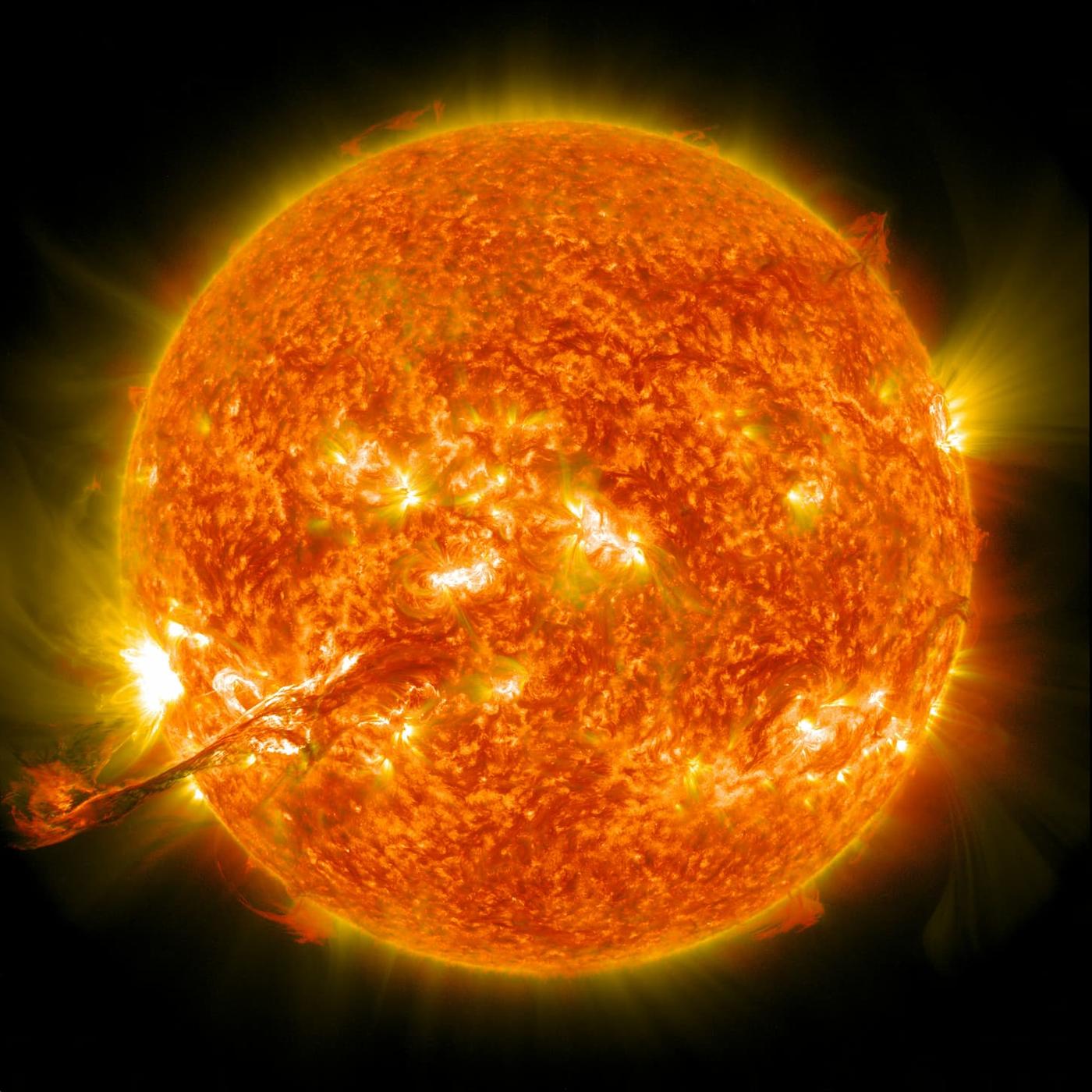
You probably haven't thought much about the Sun today. It showed up, lit the sky, and carried on doing what it's done for billions of years. But once you start looking a little closer, that giant glowing ball overhead becomes a lot less comforting and a lot more unsettling.
The weirdest part? Every fact below is happening right now, whether you're checking your phone, making coffee, or sitting in traffic.
1. The Sun Could Fit More Than One Million Earths Inside It
The Sun looks manageable because it's far away. Really far away. In reality, you could pack about 1.3 million Earths inside its volume. If Earth were the size of a grape, the Sun would stand about as tall as a two-story house. And despite that ridiculous size difference, the Sun still counts as a fairly average star. Space has plenty of stars that make our Sun look small.
2. You Never See the Sun in Real Time
Every time you look at the Sun, you're seeing the past. Light takes about eight minutes and twenty seconds to travel from the Sun to Earth, so the image reaching your eyes already has a built-in delay. If the Sun somehow vanished right now, you wouldn't notice for more than eight minutes. You'd continue scrolling, walking, and living your day completely unaware that the source of all life had disappeared.
3. The Sun Is Constantly Losing Millions of Tons of Material
The Sun burns through roughly four million tons of matter every second. That sounds like a disaster, but it's actually how stars generate energy. They convert matter directly into energy through nuclear fusion. Four million tons per second feels impossible until you remember the Sun weighs about 2 octillion tons. At its current rate, it can keep this up for billions more years without breaking a sweat.
4. Its Surface Is Cooler Than You Think
Most people imagine the Sun's surface as the hottest part. It isn't. The visible surface sits at around 5,500°C, which is already terrifying. But the Sun's outer atmosphere, called the corona, reaches temperatures of more than a million degrees Celsius. Scientists still debate exactly why this happens. Imagine standing farther away from a campfire and somehow feeling hundreds of times hotter. That's basically the mystery.
5. The Sun's Gravity Controls the Entire Solar System
Everything in the solar system dances to the Sun's tune. Its gravity holds planets, asteroids, comets, and countless smaller objects in orbit. The Sun contains about 99.8% of all the mass in the solar system. Jupiter gets a lot of attention for its size, but the Sun outweighs it by more than a thousand times. Without that gravitational grip, every planet would shoot off into deep space.
6. Solar Storms Can Knock Out Modern Technology
The Sun occasionally launches huge bursts of charged particles into space. When those particles slam into Earth, they can interfere with satellites, GPS systems, power grids, and radio communications. In 1859, a massive event called the Carrington Event sent sparks flying from telegraph equipment. Some systems reportedly kept operating after operators disconnected their power supplies. A storm of that size today could cause chaos across modern infrastructure.
7. You're Standing Inside the Sun's Atmosphere Right Now
This one feels wrong, but it's true. The Sun constantly releases a stream of charged particles called the solar wind. That wind extends far beyond Pluto, creating a giant bubble known as the heliosphere. Earth sits comfortably inside it. So while you're definitely not inside the Sun itself, you are moving through material that came directly from it. The Sun's atmosphere stretches much farther than most people realize.
8. The Sun Doesn't Burn Like Fire
When people picture the Sun, they often imagine a giant ball of flames. But fire requires oxygen, and space doesn't provide much of that. The Sun produces energy through nuclear fusion deep inside its core, where hydrogen atoms smash together and form helium. Every second, unimaginable numbers of these reactions take place. The process has more in common with a giant fusion reactor than a campfire.
9. A Tiny Piece of the Sun Could Destroy a City
The Sun's core reaches temperatures of around 15 million degrees Celsius. If you could somehow transport a small chunk of solar material to Earth, even a piece the size of a sugar cube would release catastrophic amounts of energy. Of course, solar material can't survive intact outside the Sun's extreme conditions. Still, it's unsettling to think that the harmless-looking disk in the sky contains forces far beyond anything humans have created.
10. The Sun Will Eventually Kill Life on Earth
Forget the dramatic movie version where the Sun explodes tomorrow. The real story happens slowly. As the Sun ages, it grows brighter and hotter. Long before it becomes a red giant, Earth's oceans will begin to evaporate and the planet will become increasingly hostile to life. Scientists estimate this process starts on a meaningful scale in about a billion years. That's comfortably far away, but it's already built into the schedule.
The Sun feels familiar because you've seen it every day of your life. But familiarity hides just how strange, powerful, and slightly terrifying it really is. Share this with someone who thinks space is boring, then watch their expression when they reach number 7.

Clara Rhodes
Author at SofaBreak — writing on facts and everyday curiosities.